Reception · Phase 2 · Start here
How to say the phonics sounds properly
A parent's guide to pure sounds, with every Phase 2 sound and the slip most of us make. Many of us learnt letter names before sounds, so if this feels new, you're in good company.
The short version
- Say the sound, not the letter name. "sss", not "ess".
- Keep it pure. No "uh" on the end: "t", not "tuh".
- Follow how your child's school says it. If this guide and school differ, school wins.
Why the way you say sounds matters
Schools in England teach reading with systematic synthetic phonics. Children learn the sound that each letter, or group of letters, stands for. Then they blend those sounds together to read a word.
Blending only works if the sounds are clean. Try it: say "suh – a – tuh" quickly. You get something like "suhatuh", which isn't a word your child knows. Now say "sss – a – t". Run it together and you hear sat.
That extra "uh" is called a schwa, and almost all of us add it without noticing. Taking it off is the single most useful change you can make at home. Teachers call the clean version a pure sound.
Sounds first, letter names later
When your child reads the letter a, the answer they need is "a" as in apple, not the name "ay". Letter names don't help with reading: "see-ay-tee" doesn't sound anything like cat.
The alphabet song is fine, and children do learn letter names, usually a little later in Reception. Just keep names and sounds separate: when you're reading or spelling together, use sounds. If you're not sure when your school introduces names, ask the class teacher.
Stretchy sounds and quick sounds
On the sound mat, a wavy line means a sound you can hold, and a dot means a quick sound.
- Stretchy sounds can be held for as long as you have breath: s, m, n, f, l, r, v, z, sh, th and ng (and the doubles ff, ll, ss and zz). Hold them for a moment so your child can hear them: "mmm", "sss".
- Quick sounds can't be held without changing: t, p, d, b, g, c, k, ck, h, j, ch, w, y, x, qu and nk. Say them short and crisp, then stop.
- The short vowel sounds a, e, i, o and u are kept short too: a as in apple, not a long "aaaa".
If your school holds sounds for longer or shorter, copy them.
Whispered sounds and voiced sounds
Rest your fingers on the front of your throat. Say "sss": nothing buzzes. Now say "zzz": you feel a buzz. That buzz is your voice.
Many sounds come in pairs that are made the same way, one whispered and one voiced: p and b, t and d, k and g, f and v, s and z, ch and j. The whispered ones have no voice at all, so there's nowhere for an "uh" to hide. The voiced quick sounds (b, d, g, j) will carry a tiny bit of voice. Just keep it as short as you can: "b", not "buh".
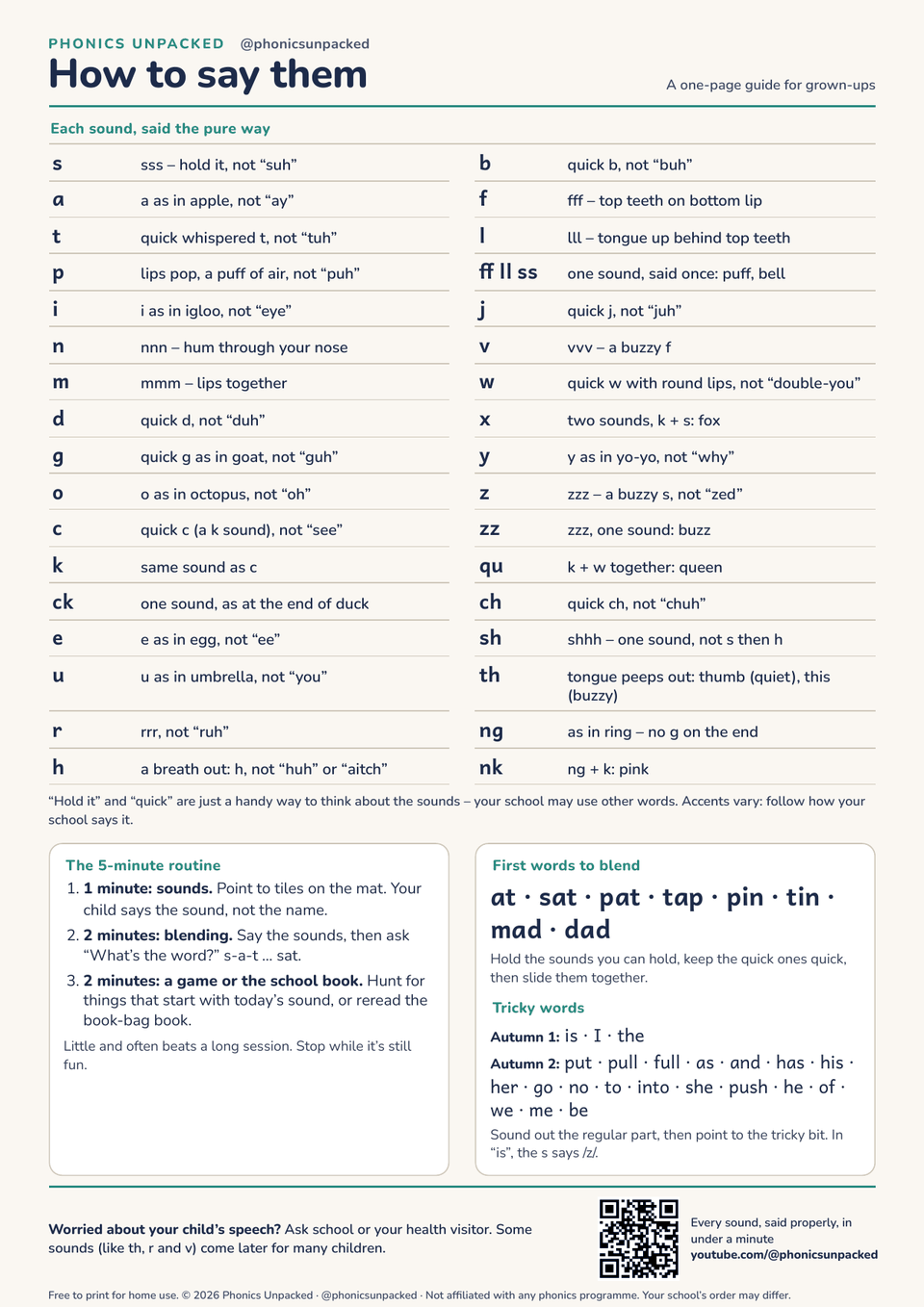
How to say the first 20 sounds
These are usually taught in the first half of the autumn term in Reception, a few a week, in roughly this order.
| Sound | How to say it | Avoid |
|---|---|---|
| ssock | Stretchy and whispered. Teeth together, let the air hiss: "sss". | suh ess |
| aapple | Quick. Mouth open, a short "a". | ay |
| ttap | Quick and whispered. Tongue tip taps just behind your top teeth. | tuh tee |
| ppig | Quick and whispered. Lips together, then a small puff of air. | puh pee |
| iigloo | Quick. A short "i". | eye |
| nnet | Stretchy. Tongue behind your top teeth, hum through your nose: "nnn". | nuh en |
| mmap | Stretchy. Lips together, hum: "mmm". | muh em |
| ddog | Quick. Tongue taps behind your top teeth, with a little voice. | duh dee |
| ggoat | Quick. The back of your tongue lifts and lets go, with a little voice. | guh jee |
| ooctopus | Quick. Round mouth, a short "o". | oh |
| ccat | Quick and whispered. The back of your tongue lifts and lets go. | kuh see |
| kkite | Exactly the same sound as c. | kuh kay |
| ckduck | The same sound again: two letters, one sound. Usually at the end of short words. | Saying c, then k |
| eegg | Quick. A short "e". | ee |
| uumbrella | Quick. A short "u", mouth relaxed. | you |
| rrobot | Stretchy. A soft growl: "rrr". | ruh ar |
| hhat | Quick. Just a breath out, as if steaming up a mirror. | huh aitch |
| bbat | Quick. Lips together, pop them open with a little voice. | buh bee |
| ffish | Stretchy and whispered. Top teeth on your bottom lip: "fff". | fuh eff |
| llolly | Stretchy. Tongue tip up behind your top teeth: "lll". | luh el |
How to say the next 16 sounds
These usually follow in the second half of the autumn term. Several are digraphs: two letters that make one sound.
| Sound | How to say it | Avoid |
|---|---|---|
| ffpuff | The same as f. Two letters, one sound. | Saying it twice |
| llbell | The same as l. | Saying it twice |
| ssdress | The same as s. | Saying it twice |
| jjam | Quick, with voice, as at the start of jam. | juh jay |
| vvan | Stretchy. Like f with your voice switched on: "vvv". | vuh vee |
| wweb | Quick. Small round lips that open, as at the start of web. | wuh double-you |
| xfox | Two quick sounds together, "ks", as at the end of fox. | ex |
| yyo-yo | Quick, as at the start of yes. | yuh why |
| zzip | Stretchy and buzzy: "zzz". | zuh zed |
| zzbuzz | The same as z. | Saying it twice |
| ququeen | Two sounds said together: "kw". | kyoo |
| chchips | Quick and whispered, like a tiny sneeze. | chuh |
| shsheep | Stretchy and whispered. Finger on your lips: "shhh". | shuh, or s then h |
| ththumb | Stretchy. Tongue tip peeps out between your teeth. Whispered in thumb, voiced in this. | thuh, or t then h |
| ngring | Stretchy. Back of your tongue up, hum through your nose. | Adding a "g" on the end |
| nkpink | The ng sound, then a quick whispered k. | Saying n, then k |
One more thing your child will meet this term: an s at the end of a word sometimes says /z/, as in dogs, bags and his. If they read "dogz", they're right.
What about accents?
Say the sounds in your natural voice. Vowels in particular change from region to region: the u in bus, or the a in bath and grass, can sound quite different in Leeds and in Kent. That's fine. Your child's teacher will usually say them in the local way too.
What matters is that the sounds are pure and consistent. Putting on a "proper" voice for phonics is more likely to confuse your child than help.
From sounds to words: blending
Once your child knows a few sounds, they start to blend them. You can begin without any letters at all. This is called oral blending:
- Say the sounds of a word slowly: "s – a – t".
- Ask your child, "What's the word?"
- If they're stuck, say the sounds a little faster, then say the word yourself and move on. No pressure.
Good first words: at, sat, pat, tap, pin, tin, nap, mad, dad. When your child can do this easily, try it with letters: point under each letter as you both say the sound, then "say it fast".
Three slips most of us make
- Adding "uh". It's a habit, so expect to catch yourself. Whispered sounds (s, t, p, f, sh) are the easiest place to start getting it right.
- Mixing letter names into sounding out. "What does it start with?" "See" is unhelpful. Point to the letter and say its sound instead.
- Correcting speech instead of modelling. Lots of young children say "fumb" for thumb or "wabbit" for rabbit; many sounds take a few years to settle. Just say the word back clearly and carry on. If you have any concerns about your child's speech, talk to their teacher.
A 5-minute routine
- 1 minute: sounds. Point to five or six sounds on the mat that your child has learnt this week. They say the sound.
- 2 minutes: blending. Say three or four words in sounds and let them work out the word.
- 2 minutes: a game or the book. A sound hunt round the kitchen, or the book from the book bag.
A few minutes on most days beats a long session at the weekend. Stop while it's still fun.
Questions parents ask
My child's school says a sound differently from this guide. Who's right?
Go with school. Programmes and teachers vary a little in how they model some sounds, and it's more important that your child hears one consistent version than any particular one.
Should I teach capital letters?
Most schools start with lowercase letters, because that's what most words in books are made of. Capitals usually come up naturally, starting with your child's name. Follow your school's lead.
What's a digraph?
Two letters that make one sound, such as sh, ch, th, ng and ck. A trigraph is three letters making one sound, such as igh in night, which comes in the spring.
What are tricky words?
Words with a part your child can't sound out yet, such as the s in is, which says /z/. Most of the word can still be sounded out, so help your child spot the tricky bit rather than learn the whole word as a picture.
My child is in Nursery. Is it too early?
Playing with sounds is never too early: rhymes, "I spy" with sounds rather than letter names, and oral blending games. Leave the written letters to school unless your child is keen.
Free printable
Put it on the fridge
The Phase 2 sound mat has all 36 sounds on page 1 and this guide's key points on page 2. Free, no email needed.
Get the free sound matPhonics Unpacked isn't affiliated with any phonics programme. Your school's order and wording may differ, so always follow your school.